Thanatopsis zine was established in 1994. 3 issues were released between 94-98. 1st issue was "Open Minded" and had interviews with all sorts of bands in the underground, regardless of genre. Issue 2 and 3 concentrated on metal only. With the advances in technology and the internet, Thanatopsis zine has emerged as a blog/e-zine.
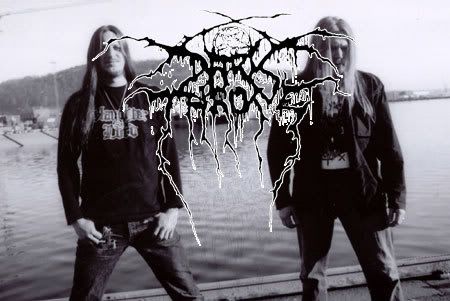
My old buddy Rammy has an exclusive interview with Fenriz of Darkthrone! This was Rammy's 1st interview since stopping Kemenyan fanzine in 2006.
Wow, real in depth interview from Fenriz - he talks about Darkthrone (obviously), life, musical tastes, years of the Underground scene and Michael Jackson!
Austrian blackened death metal outfit BELPHEGOR have completed their work on the eighth full-length studio album, Walpurgis Rites - Hexenwahn, due later this year via Nuclear Blast Records.
Walpurgis Rites - Hexenwahn was recorded at Andy Classen's (LEGION OF THE DAMNED, DEW-SCENTED, NEAERA, ASPHYX) Stage One Studios in Kassel, Germany.
Commented frontman Helmuth: "With these nine compositions/arrangements, we continue to piss on the damn mainstream. It's BELPHEGOR to the highest; the hymns are extremely varied, more intense and epic than ever, [and] there are new elements and structures added. Also, we used some haunting samples here and there, to give the album a cold and ritualistic feel."
He continued... "On Walpurgis Rites - Hexenwahn, you will hear my most fucked up vocals to date; also the lyrical content is offensive and insane. The witch/devil concept is amazing to work with and we used alot of original chants/ incantations from archaic scripts."
BELPHEGOR has tapped Brazilian artist Marcelo Hvc to handle the graphics for the new album. Marcelo has already begun working on the cover art and "some magickal images," according to a press reelase.
Added Serpenth:
"The idea is to capture the okkultic orgiastic processions from the Broken Mountain, the Walpurgis night in the images."
Huh, sungguh x sangka susah benar nak membesarkan anak-anak ni. Kami anak 2 orang pun dah rasa jenuh dah ni. Tambah-tambah lagi orang yg anak lebih....
Baru la aku tau betapa susahnya mak bapak aku membela & membesarkan kami 3 beranak.
Sungguh seronok melihat gelagat anak-anak dan semua milestones yg dicapai, tapi ada juga time time tension dengan anak2 yg manja, susah nak tidoq, kacau adik & teriak yg sungguh ngilu!
Posting ni aku dedikasikan kepada para ibubapa, x kira la anak dah tua ka atau baru lahir. Ya Allah, tingkatkanla tahap kesabaran kami & keimanan kami dalam membesarkan anak2 kami. Amin
Selamat menempuh alam ke-ibubapaan.
Kepada mama & ayah aku - sekarang baru aku faham... hehehe
Those involved in the metal scene or occult/horror sure have heard of Countess Bathory. Venom has sung about her, Tormentor has sung about her and Cradle of Filth dedicated an album just for her. Oh, don't forget the legend that is Bathory - Quorthon's band. Hell, there's even a movie I saw on Sky Movies recently about the Blood Countess. That movie sucked balls! Featuring the girl from the Final Destination series (she survived pt 1 and was in pt 2) - it's about a video game that was based on Bathory and players die in mysterious circumstances.
Anyway, I was fascinated by her life as well. In my search for her story, I found this article years back and posted it on the Thanatopsis website. It got a lot of hits from Google! Here it is republished here.
The article was written by Mathew Amaral. I was contacted a few times about this article by Mathew saying there were corrections etc since it was released. He's now wrote a book about Bathory, find it at Amazon if you're interested.
A Brief on the life and death of Hungary's infamous Blood Countess, Elizabeth Bathory-Nadasdy by Mathew Amaral
The infamous "Blood Countess" of Transylvania, who was purported to be a witch, vampire, werewolf, and supposedly bathed in the blood of virgins in order to maintain her beautiful and youthful appearance, has been the subject of many legends some of which have affected even the American culture half a world away. Dracula, created by the Irish author Bram Stoker, was based, albeit loosely, on the Romanian Prince, Vlad Dracula, the Impaler. Raymond T. McNally, who has written four books on the figure of Dracula in history, literature, and vampirism, in his fifth book, "Dracula was a Woman," presents insights into the fact that Stoker's Count Dracula was also strongly influenced by the legends of Elizabeth Bathory of Hungary. Why, for example, make a Romanian Prince into a Hungarian Count? Why, if there are no accounts of Vlad Dracula drinking human blood, does blood drinking consume the Dracula of Stoker's novel, who, contrary to established vampire myth, seems to appear younger after doing so? The answers, of course, lie in examining the story of Countess Elizabeth Bathory.
Though a majority of Elizabeth's exploits are reputed to have taken place in a castle which is today called Cachtice ("Chakh-teetsay"), that stands in an area of Transylvania (meaning "the land beyond the forest" in Latin) which, in 1983, rested within Czechoslovakian borders, the story of her life begins on what was once the border between Romania and Hungary (in 1983) at Ecsed Castle, the Bathory family seat in Transylvania. Born in 1560 to George Bathory (Ecsed branch) and Anna Bathory (Somlyo branch), Elizabeth was yet another product of the intermarriage between the dwindling Hungarian noble families. The Bathory family was "one of the richest and most powerful Protestant families in all Hungary. Her family was to provide two of the most important ruling princes of Transylvania, a number of war heroes and church officials of Hungary, and even a great empire-builder, Stephan Bathory, prince of Transylvania and king of Poland"(18). The common practice of inbreeding did nothing positive, however, for this illustrious family; Elizabeth's other interesting relatives included: An uncle supposedly "addicted to rituals and worship in honor of Satan, her aunt Klara was a well-known bi-sexual and lesbian who enjoyed torturing servants, and Elizabeth's brother, Stephan, who was a drunkard and a lecher"(19). Additionally, as an interesting side note, McNally mentions, "there is some genealogical evidence that the Bathory clan was related by marriage to that of the infamous ruler Vlad Dracula, the Impaler"(19). To receive some insight into the soul of Elizabeth, the presentation of an incident during her childhood could prove enlightening.
Though it is not stated exactly when, occurring sometime after she turned six and before eleven, a band of gypsies were invited to her home at Ecsed Castle to provide entertainment at the court . During their stay, one of their number was accused of selling his children to the Turks. He was found guilty and his judges sentenced him to death. "Elizabeth recalled his long cries in the night, bemoaning his upcoming demise, which evidently made a lasting impression on her. At dawn, Elizabeth escaped from the surveillance of her governess and ran outside the castle to witness the punishment. There she saw a horse held fast to the ground as some soldiers slit open its belly. Three of the soldiers then grabbed the guilty gypsy and shoved him inside the horse's belly until only his head stuck out of the dying animal. Another soldier armed with a huge, long needle and coarse ropelike thread sewed up the culprit in the belly of the horse"(21). This, along with other incidents during her childhood, would ultimately shape her views of what was proper behavior and her basic concepts of morality.
Unlike most females of the time, Elizabeth was well educated and her intelligence surpassed even some of the men of her time. Elizabeth was exceptional, becoming "fluent in Hungarian, Latin, and German... when most Hungarian nobles could not even spell or write...Even the ruling prince of Transylvania at the time was barely literate"(20). Some modern scholars and contemporaries of hers postulated that she may have been insane, thus accounting for her seemingly inconceivable atrocities, but even a brief glance into her past reveals a person fully in control of her faculties.
In 1555, Elizabeth's future husband, Ferenc Nadasdy (pronounced "Ferents"), was born to a family which, by noble right, was as prestigious as the Bathorys but not as wealthy and not as old. Ferenc's education has meticulously documented by his mother, Ursula, who was then a widow, concerning the period he was attending school in Vienna between 1567 and 1569. These documents attest that "Ferenc was not a good student. He barely learned how to write some Hungarian and to speak and read a little German and Latin.... Ferenc... developed into an athlete, but little else.... Although he acquired little academic education, he was evidently popular among his peers"(28). At the age of sixteen, Ferenc was engaged to Elizabeth, then eleven, in 1571 thanks to the careful manipulations of his mother.
Ferenc married Elizabeth on May 8, 1575 in "a lavish, gala event"(30) to which even the Holy Roman Emperor Maximilian II was invited (though he was unable to attend personally, due to the hazards of traveling during a time of political unrest, he instead "sent a delegation to represent him and an expensive wedding present"[30]). The marriage, which joined two prominent Protestant families, was held at Varanno Castle where the "bearded young Count Ferenc Nadasdy henceforth added her last name to his. But Elizabeth, fully emancipated...[by that time,]... chose to remain a Bathory, rather than take his name, since she considered that her name was much older and more illustrious than his"(30).
Ferenc chose war as his career and so was not often around, leaving Elizabeth at Castle Sarvar (prn "Shar-var") managing the family seat, "especially the task of disciplining the servants. The countess carried her 'disciplining' to a point that would be considered sadism today"(32). Beating the girl servants with a heavy club was the least of her "punishments," according to accounts. Often she would stick "pins into the upper and lower lips of the girls...into the girls ' flesh and... under their fingernails"(32). One particularly harsh "punishment" would be to drag girls out into the snow where she or her women servants poured cold water on them until they froze to death.
The first ten years of their marriage, Elizabeth bore no children because she and Ferenc shared so little time together as he pursued his "career." Then around 1585, Elizabeth bore a girl whom she named Anna, and over the following nine years gave birth to two more girls, Ursula and Katherina, and in 1598 bore her first and only son, Paul. Judging from letters she wrote to relatives, she was a good wife and protective mother, which was not surprising since nobles usually treated immediate family very differently from the lower servants and peasant classes.
Among the things Elizabeth did to amuse herself while Ferenc was away at war was to "visit her aunt Klara, an open bisexual. Wealthy and powerful, Klara always had plenty of available girls around. Elizabeth presumably enjoyed herself with her aunt Klara, since she visited her aunt's estate frequently"(33). Ferenc meanwhile had created quite a name for himself. By 1598, Ferenc was a "well-known war hero: he was one of five... sharp-sabred heroes known as 'the unholy quintet' who inspired fear in the Turks. The Turks even dubbed him with a popular nickname to indicate their fear of him, the 'Black Knight of Hungary'"(36). Also during this time, the crown began falling behind in paying their illustrious heroes and ended up owing an immense monetary debt to the Nadasdy family of which Elizabeth was now a part. Near the close of 1603, "Ferenc suddenly became very ill, and died on the morning of January 4, 1604, as a heavy snow fell on his castle at Sarvar"(38).
It is unknown whether or not Ferenc was aware of the activities of his homicidal wife while he was away, but "it is known that, when he was home, he too enjoyed torturing servants. When Ferenc was on homeleave during rare respites from warring against the Turks... Elizabeth and he had spent some time together engaging in activities that would be characterized as sadistic today.... Ferenc tortured servants, although he did not torture them to death, as his wife did "(38-9).
Only four weeks after the death of her husband in 1604, Elizabeth decided that she had mourned long enough and soon began making appearances at the court. Though many chroniclers of the Countess' story point out that the death of Ferenc was the trigger for her reputed blood baths "for cosmetic purposes"(40), the evidence first, clearly shows that her sadistic behavior (as noted previously) began well before the death of her husband, and second, indicates that there were no blood baths (not from any of the eye-witness accounts)! One old legend states that while out riding with a young gentleman, she apparently was verbally abusive to a very old woman whom she found utterly repulsive in appearance. The old woman countered with the remark " 'Take care, O vain one, soon you will look as I do and then what will you do?' "(40). This was another reason given for Elizabeth's obsession with age and aging, though there is no evidence anywhere of documents to this event. It is worthy to mention here, though it also lacks evidence as the above story does, another legend concerning the genesis of Elizabeth's blood baths:
This practice started when a maid accidentally pulled the countess's hair while combing it; Countess Elizabeth Bathory instinctively slapped the girl on the ear, but so hard that she drew blood. The servant girl's blood spurted onto Elizabeth's hands. At first the countess was enraged at this and reached for a towel to wipe off the blood. But suddenly the countess noticed that as the blood dried, her own skin seemed to take on the whiteness and youthful quality of the young girl's skin.(x)
Nonetheless, though she may not have actually bathed in the blood of her servants, several accounts of her tortures described her as being so soaked with the blood of her victims that she had to change her clothes before continuing onward. She could have continued in this fashion, torturing servant girls to death at her whim, indefinitely because even the clergy at the time felt that the nobles could treat their servants however cruelly and the servants would have absolutely nothing to say about it (legally).
In the Countess's service, as helpers in the macabre, was her manservant referred to only as Ficzko (which means "lad " in Hungarian), Helena Jo the wet nurse, Dorothea Szentes (also called "Dorka"), and Katarina Beneczky a washerwoman who came into the Countess's employ late in her bloody career. Also, between the years of 1604 and 1610 a mysterious woman named Anna Darvulia, who was probably a lover of Elizabeth's, who taught her many new torturing techniques and was "one of the most active sadists in Elizabeth's entourage"(45). After a severe stroke that left her blind, Darvulia left her work to Elizabeth, Helena Jo, and Dorka, content that she had taught them well.
Escape from the Castle Cachtice was not unheard of, though few if any actually succeeded in their attempts. One such escapee was punished as follows: ...a twelve year old girl named Pola somehow managed to escape from the castle. But Dorka, aided by Helena Jo, caught the frightened girl by surprise and brought her forcibly back to Cachtice Castle. Clad only in a long white robe, Countess Elizabeth greeted the girl upon her return. The countess was in another of her rages. She advanced on the twelve-year-old child and forced her into a kind of cage. This particular cage was built like a huge ball, too narrow to sit in, too low to stand in. Once the girl was inside, the cage was suddenly hauled up by a pulley and dozens of short spikes jutted into the cage. Pola tried to avoid being caught on the spikes, but Ficzko maneuvered the ropes so that the cage shifted from side to side. Pola's flesh was torn to pieces.(47)
With the death of Elizabeth's dear Darvulia, when Elizabeth was in her forties, she became more reckless. It was Darvulia that made sure that the victims were only peasants and that no girl of noble birth was taken, but with her passing, and the fact that local peasants were getting wise to the wonders of Castle Cachtice, Elizabeth started picking girls from some of the surrounding lower nobility. Feeling lonely, the Countess turned to the widow of a tenant farmer from the nearby town of Miava. The woman's name was Erzsi Majorova (The last name is, by the way, a corruption of the Hungarian word majoros meaning "tenant farmer," with a Slovak feminine ending "-ova" added to it [47-8]). Apparently, it was Erszi Majorova who "encouraged Elizabeth to go after girls of noble birth as well as peasants"(48).
Elizabeth's atrocities continued:
One accomplice testified that on some days Elizabeth had stark- naked girls laid flat on the floor of her bedroom and tortured them so much that one could scoop up the blood by the pailfull afterwards, and so Elizabeth had her servants bring up cinders in order to cover the pools of blood. A young maid-servant who did not endure the tortures will and died very quickly was written out by the countess in her diary with the laconic comment "She was too small,"... At one point in her life Elizabeth Bathory was so sick that she could not move from her bed and could not find the strength to torture her miscreant servant girls.... She demanded that one of her female servants be brought before her. Dorothea Szentes, a burly, strong peasant woman, dragged one of Elizabeth's girls to her bedside and held her there. Elizabeth rose up on her bed, and, like a bulldog, the Countess opened her mouth and bit the girl first on the cheek. Then she went for the girl's shoulders where she ripped out a piece of flesh with her teeth. After that, Elizabeth proceeded to bite the girl's breasts. (50-1)
On the bright side, Elizabeth went out of her way to see to it that the dead girls were given proper Christian burials by the local Protestant pastor, at least initially. As the body count rose, the pastor refused to perform his duties in this respect, because there were too many girls coming to him from Elizabeth who had died of "unknown and mysterious causes." She then threatened him in order to keep him from spreading the news of her "hobby" and continued to have the bodies buried secretly. Near the end, many bodies were disposed of in haphazard and dangerously conspicuous locations (like nearby fields, wheat silos, the stream running behind the castle, the kitchen vegetable garden, etc.).
Throughout her reign as the "Blood Countess," after her husband's death, she sought to make the Hungarian king Matthias II repay the debts he owed her dear departed Ferenc in order for her to continue her rather pricey pastime. The King didn't pay up and Elizabeth resorted to selling her family castles around Transylvania (she eventually sold a total of two). These actions caught the attention of her "cousin" Count Thurzo. The Count, recognizing the danger of her conspicuously dangerous actions gathered the rest of the Bathory clan and planned to spirit her off to a convent "where she would end her days"(61).
Count Thurzo's plans to save the family name was thwarted when:
In the winter of 1610 Elizabeth evidently still felt that her social position made her virtually untouchable before the law, since she had her servants toss four murdered girls from the ramparts of Castle Cachtice into the path of roaming wolves. This was done in full view of the Cachtice villagers, who reported this latest atrocity to the king's officials. (64)
The king and the high church officials ordered Count Thurzo to act, and that he did, only he wanted to handle things the way that would best suit the Bathory family. He planned his raid to happen over the Christmas holiday, while the Hungarian Parliament was not in session. On December 29, 1610, Count Thurzo's raid on Cachtice Castle took place:
There was no midnight raid on Elizabeth's castle, because there was no need for any. Over the years there had been abundant evidence built up against the countess. When the raiding party arrived at Elizabeth's manorhouse in Cachtice, they found the beaten body of...[a servant girl]... before the door. Elizabeth and her cohorts had not yet bothered to bury the body. Inside the house the nobles found two other female victims. (71) In a letter to his wife, Count Thurzo wrote:
"I took the Nadasdy woman into custody; she was immediately taken to her fortress... She will be well watched and held in strict imprisonment until God and the law decide about her... I await only until the accursed woman has been deposited in the fortress and a suitable room found for her. (74)
Count Thurzo, however, had not waited for God and the law for he had already secretly arranged and decided that she would not be brought to trial, that she would be sentenced to life imprisonment within her castle at Cachtice. The trials on January 2 and 7 of 1611 were largely for show and to make the occasion "official." At the proceedings, the testimonies of her four accomplices, Ficzko, Dorka, Katarina Beneczky, and Helena Jo (Erzsi Majorova was tried much later because she could not be found) were taken and their sentences pronounced. It is somewhat important to mention here that the testimonies of the four placed the body count between thirty and sixty, but a fifth witness heard at the January 7th trial revealed the missing piece of the puzzle:
...the most surprising testimony came from a witness identified only as "the maiden Zusanna," no last name being mentioned. After describing the tortures by Helena Jo, Dorothea, and Ficzko...and after making a plea for mercy in the case of Katarina Beneczky, Zusanna then revealed the single most shocking piece of evidence in this trial... a list or register in the Countess's chest of drawers, which put the number of girls killed at 650 and that was in her Ladyship's own handwriting.(79) The servants were then judged guilty and their punishments meted out as follows:
...first of all, Helena Jo and secondly Dorothea Szentes, the so- called foremost perpetrators of such great crime, were sentenced to having all their fingers on their hands, which they had used as instruments in so much torture and butcherings and which they had dipped in the blood of Christians, torn out by the public executioner with a pair of red-hot pincers; and after that their bodies should be thrown alive on the fire. Because of his youthful age and complicity in fewer crimes, Ficzko was only to be decapitated. After that his body, drained of blood, was to be reunited with his two fellow accomplices and burned... Only Katarina Beneczky escaped the death sentence. Later on January 24, 1611... Erzsi Majorova... was also found guilty and executed. (81-2)
Only Elizabeth was not brought before a court and tried, thanks to a letter campaign led by her powerful family and the machinations of Count Thurzo. Sentence, however was passed on her, by Count Thurzo himself: " 'You, Elizabeth, are like a wild animal,' he told her, 'you are in the last months of your life. You do not deserve to breathe the air on earth, nor to see the light of the Lord. You shall disappear from this world and shall never reappear in it again. The shadows will envelop you and you will find time to repent your bestial life. I condemn you, Lady of (Csejthe) Cachtice, to lifelong imprisonment in your own castle.' "(84).
Workers were called in to wall over the windows and the door of the room in Cachtice Castle where she would spend her remaining days with only a small opening for food to be passed to her, and some ventilation slits. Additionally, "four gibbets were built at the four corners of the castle in order to demonstrate to the peasants that 'justice' had been done"(87).
On July 31, 1614, Elizabeth dictated her last will and testament to two cathedral priests from the Esztergom bishopric. She wished that what remained of her family holdings be divided up equally among her children, her son Paul and his descendants were the basic inheritors though.
And regarding her death:
Late in August of the year 1614 one of the countess's jailers wanted to get a good look at her, since she was still reputedly one of the most beautiful women in Hungary. Peeking through the small aperture in her walled-up cell, he saw her lying face down on the floor. Countess Elizabeth Bathory was dead at the age of fifty-four. (88)
Her body was intended to be buried in the church in the town of Cachtice, but the grumbling of local inhabitants found abhorrent the idea of having the "infamous Lady" placed in their town, on hallowed ground no less! Considering this, and the fact that she was "one of the last of the descendants of the Ecsed line of the Bathory family"(88), her body was placed to the northeastern Hungarian town of Ecsed, the original Bathory family seat.
Much of Countess Bathory's atrocities were left out of this brief for reasons of length and taste, but I hope that the basic flavor of her deviance can be felt and the myth concerning her "blood baths" dispelled. Some still consider her to be more of a werewolf than a vampire because, rather than drinking the blood of her victims, she bit their flesh- a supposed tell-tail in those circles, I suppose. But now, considering the legend with the reality, it is not difficult to see where Bram Stoker found his prototype for Count Dracula, and perhaps someday Elizabeth will receive the credit due her.
One of the songs I love from Venom, Countess Bathory. I love to play this song, wish I had somebody to play it with here in NZ.
Kisah bermula pada petang ni. Aku mula2 nak iron baju nak pegi keja esok. Dok pilih baju, tgk2 ada 1 baju puith aku collar mcm pudar sket disebabkan basuh dgn baju gelap. Bengkek aku! So merungut kat isteri. Isteri pun cakap la, basuh la baju tu saja dgn tudung putihnya, hopefully akan hilang pudar tu.
Aku pun turun la basuh baju. Letak baju tu dgn tudung isteri. Letak 'cotton stains', temp letak 60, 1200 rpm spin. Sementara tu, isteriku dok bagi anak2 mandi dlm bathtub kat atas.
Lepas tu, aku mula nak naik tangga ke atas. Tengah kaki melangkah, aku dengar "mummy adik beyak!". Punya la tergelak besaq aku sambil dok naik tangga!
Sahih, aku naik atas, isteri tengah dok berus gigi. Aiman dah keluaq dari bathtub, Aliya still dlm bathtub, muka pelik... Ada la 2 ketui taik dlm bathtub. Panjang plak tu, dlm 4-5cm each! hahahaha...
Nasib taik kira keras sket, so x la air bathtub colour taik. Basuh la aku pungkoq Aliya & buka plug bathtub.
Aliya oh Aliya, dah tiga kali Aliya berak dlm bathtub. Sekali kena kat aku, 2nd kat bini aku, ketiga kali ni.
Lawak la karenah anak2. Terlalu byk utk di cerita. Tapi hari ini aku tergerak nak tulis pasai ini.
Apa cerita kelakar anak korang? Sure byk bukan? Sesapa yg x kawin & x dak anak ni, jaga anak mmg susah & payah, tapi benda2 macam ni yg kelakar & worth having kids.
Tadi dekat facebook ada kawan aku post gambar time kami kat sekolah menengah dulu - circa 1996. Sekolah Menengah Sains Tuanku Syed Putra (SMSTSP) Kangar, Perlis. Gambar tu kami dekat dewan makan, rasanya hari Jumaat kot, sebab pakai baju Melayu semua. Sungguh kurus aku time tu, tak sangka... kekeke ada la x-schoolmates aku comment kat gambar tu, cakap ada berita dalam BH pasal bekas Ustaz aku, Ustaz Rashid.
Dia ni punya la kira alim dulu. Aku ingat lagi, setiap hari, semua student laki kena turun solat jamaah. So dia akan datang dengan memakai serban & jubah, bersama sama dengan memegang rotan untuk tibai kami semua yg lambat turun solat.
Selain dia ajar PI (pendidikan Islam) dia ajar BA (bahasa Arab) jugak. Memang kami tau dia ni aktif dlm PAS. Dia pun cuba la dok 'didik' kami pasal politik sket2. Time kami form 2, or form 1 aku pun dah x igt dah la, maklum la lebih 10 tahun dah, dia ajar boys class aku senaman harimau. Takkan x tau kot apa itu senaman harimau. Kami pun naik syok la, apa lagi. Kami pun penah pergi solat & makan malam kat rumahnya kat Santan.
Time aku form 3 kot, dia kena tukar ke sekolah kat Padang Besar, again x igt sebab dia orang PAS. Time tu jugak ada sorang lagi cikgu yg pro BN - cikgu Mat Hasan, yg kini MP untuk Kuala Perlis.
Last aku dengar cerita pasai Ustaz Rashid ni last year time election dulu. Dia bertanding untuk DUN Santan & kalah. Sampai la hari ni kawan aku bagi comment kat gambar kami kat facebook.
Aku mmg tiap2 hari akan baca paper - especially UM, BH, The Star, NZ Herald. Tapi hari ni sibuk x sempat nak baca kat hospital.
So aku pun baca & sambil tu obviously cari news pasal Ustaz Rashid.
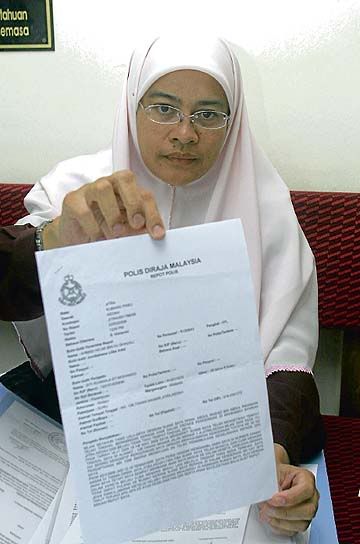
Apa dah jadi ni? Kawin 10 tahun, nafkah hanya RM300. Nafkah batin, jangan cakap la, ni sure hasil senaman harimau ni.
"Dari segi batin dia tidak pernah lupa. Kalau boleh setiap hari dia mahu sehingga kadangkala dia tetap memintanya walaupun saya dalam pantang," katanya.
Apa dah jadi kepada Ustaz Rashid?
"Dari luar dia memang kelihatan baik dan warak, tetapi sebenarnya dia lelaki yang kejam dan panas baran," katanya.
Aku pun malas nak kata apa la, tapi orang-orang yang macam ni dok bagi Islam a bad name dan terkena la kat PAS sekali sebab dia dulu calon PAS & Ketua Ulama PAS Perlis. Meluat aku tengok dalam news banyak betul 'kesilapan & kekejaman' org Islam. Riot kat Iran, suicide bombers merata.
Malu aku jadi student dia masa ni. Kredibiliti dia sbg org alim & warak dah hilang bagi aku. Adala junior aku buat status update kat fb, kata ni political conspiracy ka? Aku rasa tidak, ni real life. Takkan bini dia saja nak buat camtu kot. Bini dia ustazah, pakai tudung labuh semua. But then again, Malaysia had Saiful Azlan (betui ka? ingat2 lupa nama) & Anwar debacle. Kalau betui both things are politically motivated, how low can you go & what price?
I'll still remember my school days with fondness, but I'll try and forget this news story I read today about my dear old Ustaz...
Wow, talk about commitment to the arts. Read this in the CM (Century Media) newsletter. Looks like the Norwegian Embassy in Washington DC saw Enslaved & Opeth while they were playing there. Don't know if any of them were fans but just shows how open the Norwegians are. They did mention that Enslaved & Opeth are a 'death metal' band, which are NOT TRUE (now anyway). Enslaved are now a 'progressive metal' band while Opeth I'd say are the same, previously 'viking metal' & 'death/doom metal' were the respective musical styles.
If only Malaysia's Government was as supportive as this and not just saying Black metal is a cult and is Haram...
You can’t say the Norwegian Embassy doesn’t take seriously its commitment to supporting the country’s art. Even when that art happens to be death metal.
On Wednesday night, the Norwegian death metal band Enslaved played the 9:30 Club, its first show in D.C. (Sample lyrics, for the uninitiated: “As we emerged/From darker dungeons/Splendor of yellow hells/Expanded swollen eyes.”) And, to the crowd’s surprise and delight, there were a group of embassy staffers in the VIP section, getting a shout-out from front man Grutle Kjellson. Anne Myklebust, a cultural adviser at the embassy, said she and four of her colleagues went to see the show. But that wasn’t by any means the beginning of their support. She said the embassy helped the band out with funding for its U.S. tour. So “they asked if they could see the embassy,” and Wednesday afternoon, the band met with Ambassador Wegger Strommen for an hour.
Did they wear suits?
“No,” Myklebust laughed. “They wore their road wear of T-shirts and shorts. But the ambassador wore a suit.”
The second half of the night’s bill: Swedish metal band Opeth. So were any staffers from the Swedish Embassy on hand? “We know them pretty well, but we didn’t see any of them,” Myklebust said.
The Swedish Embassy was closed Thursday afternoon, so we couldn’t confirm that no one attended. But maybe the Norwegian Embassy just rocks harder.
CM news letter via washingtonexaminer